Author: Shail Rao-Rane, Researcher & Yoga Therapist
In Sanskrit, tri means “three,” kona means “angle” or “corner,” and asana means “posture.” Hence, Trikonasana translates to “three corners” and is commonly known as Triangle Pose in English. This standing, beginner-level yoga pose is fundamental in almost all styles of yoga. Interestingly, Triangle Pose (Trikonasana) is a relatively modern addition to yoga practice, first appearing in Iyengar Yoga. It is a great posture to open the hips and stretch the muscles around the spine.
Variations of Trikonasana

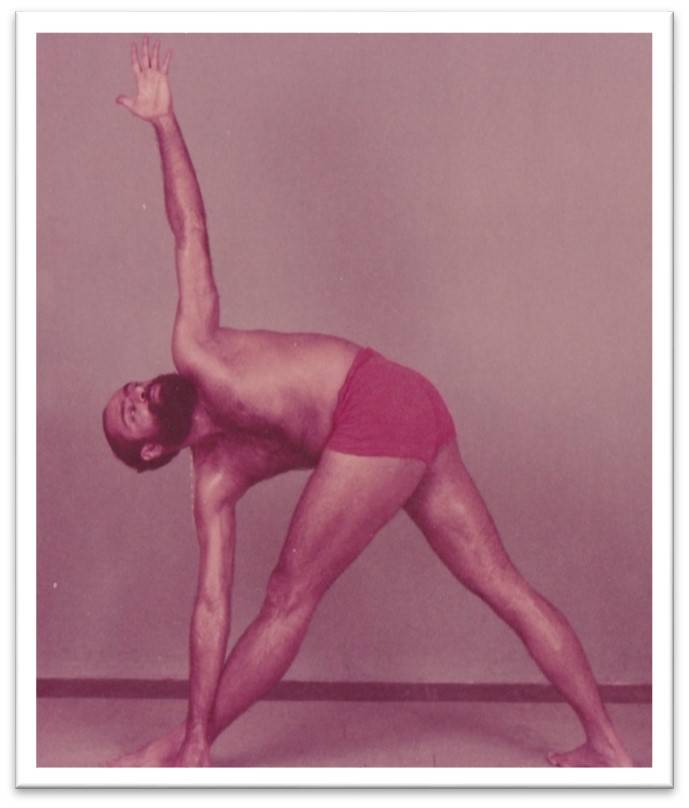
- Utthita Trikonasana (Extended Triangle Pose)
This is a more intense variation of Triangle Pose, requiring greater hip flexibility. It deeply stretches the side abdominal muscles and hamstrings. However, the hip flexibility required for Triangle Pose is more challenging due to the deeper outer rotation involved, as the arms align behind the extended foot. The hamstrings are not stretched as deeply as in Utthita Trikonasana. - Triangle Pose Hand in Front
This easier variation of Triangle Pose is typically introduced by yoga teachers to assess a student’s hip flexibility before progressing to Trikonasana or Utthita Trikonasana. - Extended Triangle Pose Block (Utthita Trikonasana Block)
This beginner-friendly variation uses props like a block. The block can be placed vertically or horizontally to suit the practitioner’s comfort level, easing the transition into the full Triangle Pose.
Preparatory Variations for Triangle Pose
To prepare the body for the final pose, the following variations can be practiced:
- Triangle Pose Prep Arms Up
- Triangle Pose Variation Bent Knee (Trikonasana Variation Bent Knee)
- Triangle Pose Block Wall Behind (Trikonasana Block Wall Behind)
- Five-Pointed Star Pose (Utthita Tadasana)
Benefits and Applications
For Athletes and Runners
Triangle Pose is excellent for stretching the hamstrings, improving agility, and enhancing balance, making it ideal for athletes and runners.
Who Should Avoid It
- Senior Citizens: The balancing aspect and joint involvement may be challenging.
- Pregnant Women (Third Trimester): The pose exerts pressure on the hip and knee joints, and the weight of the womb may create imbalance.
- Postnatal Women: Women regaining strength in their hip and pelvic joints should avoid this pose, as it is a hip opener.
Physical and Energetic Benefits
Trikonasana balances the Root Chakra, Heart Chakra, and Sacral Chakra. It stretches and strengthens various muscles and joints, including the thighs, knees, hips, groin, hamstrings, shoulders, chest, spine, and ankles. It also:
- Relieves symptoms of menopause.
- Reduces back and neck pain.
- Improves digestion.
- Offers therapeutic benefits for osteoporosis and sciatica.
Symbolic Meaning of the Triangle
The triangle in Trikonasana carries symbolic meanings such as:
- Mind, Body, Spirit: Their union during practice.
- Past, Present, Future: The back leg symbolizes the past, the hips represent the present, and the front leg and arm reach toward the future.
Acceptance of the present and past is essential to move into the future.
Utthita Trikonasana (Extended Triangle Pose)
In Sanskrit, utthita means “extended” or “stretched,” trikona means “triangle,” and asana means “pose.” Variations of this pose include:
- Revolved Triangle Pose (Parivrtta Trikonasana)
- Bound Triangle Pose (Baddha Trikonasana)
These variations challenge practitioners with different ranges of motion and offer opportunities for deeper practice.
Parivrtta Trikonasana (Revolved Triangle Pose)
In Sanskrit, parivrtta means “revolved,” trikona means “triangle,” and asana means “posture.” This pose is a counter-posture to Utthita Trikonasana but is more complex. It combines an intense forward bend with a deep twist, requiring balance and openness.
Steps to Perform Parivrtta Trikonasana:
- Stand in Tadasana: Step or lightly jump your feet 3½ to 4 feet apart. Lift your arms sideways, palms facing down.
- Adjust Your Feet: Turn your right foot 90˚ outward and your left foot slightly inward (45˚–60˚). Align the right heel with the left heel.
- Raise Your Arms: Keep them parallel to the mat with palms facing down. Activate the arms and shoulders, and keep the tailbone tucked.
- Twist the Torso: With an exhalation, turn your torso to the right, square your hips, and ground the left heel firmly.
- Lean Forward: Place your left hand on the floor, a block, or the inner right foot.
- Stretch and Align: Extend both arms in a line and gaze at your top thumb if comfortable. Maintain balance.
- Hold the Pose: Stay for 30 seconds to 1 minute with normal breathing. Release the twist, return to Tadasana, and repeat on the other side.
Anatomical Focus
Parivrtta Trikonasana focuses on:
- Arms and Shoulders
- Lower Back
- Biceps and Triceps
- Core (Abs)
- Hamstrings
- Chest
- External Hips
- Psoas
- Quadriceps
Therapeutic Applications
This pose helps with:
- Digestion and constipation.
- Opening the chest, benefiting asthmatic patients.
- Relieving sciatica pain.
Benefits of Triangle Pose
- Expands the chest and shoulders.
- Increases spinal range of motion.
- Stretches the hips, calves, and hamstrings.
- Strengthens and tones the thighs, spine, and upper back.
- Stimulates blood flow to pelvic and abdominal organs.
- Detoxifies abdominal organs.
- Alleviates symptoms of arthritis, sciatica, and lumbago.