How MYC Crisis Management is Creating Stability in Uncertain Times
Alert. Aware. Active.
Imagine this: A 16-year old stands frozen as sirens wail in the distance. Her mind races, her hands shake, and she doesn’t know what to do. Now picture the same youth – calm, clear-headed, guiding students through a disaster preparedness session that makes others feel safe.
That transformation? It’s happening right now, across ten countries, virtually and in person where youth are discovering something powerful: in a world that feels increasingly out of control, the greatest strength isn’t controlling what happens around you. It’s mastering what happens within you.
This is what Mohanji Youth Club’s Crisis Management Project is all about.
When the Ground Shifts Beneath Our Feet
Let’s be honest – the world our young people are inheriting is intense. Climate disasters that used to be “once in a century” now seem to happen every few years. Social media amplifies every crisis. The pressure to have it all figured out is crushing. And somewhere in all this noise, youth are supposed to just… cope?
That’s not good enough. And that’s not what we’re building.
Since May 2025, MYC Crisis Management has been doing something different. We’re not just teaching youth what to do when things go wrong – we’re teaching them how to be the kind of person others turn to when everything’s falling apart.
We are learning from disaster management experts, military personnel, psychologists, and real-world crisis responders. We’ve partnered with India’s National Disaster Management Authority (NDMA), collaborated with relief organizations like Ammucare and ACT Foundation, and brought in everyone from retired Air Force officers to corporate safety experts to share their hard-won wisdom.
But here’s what makes this different: we’re not just filling their heads with protocols and procedures. We’re helping them understand that a calm breath during an emergency is meditation in motion. That a clear instruction amid chaos is awareness in action.

From Panic to Presence – Real Stories, Real Change
Remember that frozen teenager? She’s not hypothetical. Across various educational institutions, we’re watching kids go from “I don’t know what to do” to “Let me show you what to do.”
Through our YOU LEAD initiative – Young Leaders for Emergency Action and Disaster Response- students at schools like Bharatiya Vidya Bhavan and Kendriya Vidyalaya and centres like Mohanji Ka Aangans aren’t just learning about crisis management. They’re becoming crisis leaders. In January alone, over 150 young minds went through YOU LEAD training, many in their native languages so that language itself never becomes a barrier to safety.
The post-training feedback forms tell us something beautiful: almost every single participant reports feeling more confident about handling emergencies. But the numbers don’t capture the whole story. They don’t capture the moment a shy 14-year-old leads their first emergency response roleplay. Or when a teenager realizes they can regulate a panicked room just by staying calm themselves. Or when a young person understands, really understands, that their stability can become someone else’s lifeline.
That’s the shift we’re creating – from “What’s going to happen to me?” to “How can I help others through this?”
Learning from Those Who’ve Been There
Our expert sessions aren’t dry lectures. They’re conversations with people who’ve actually been in the thick of it. We’ve run more than 25 expert-led sessions covering everything from natural disasters to psychological resilience, from first aid basics to communication skills in emergency response. Our partnership with NDMA has brought us six intensive sessions on topics like climate change impacts, inclusive disaster response, and nature-based disaster mitigation. On average, about 30 participants join each expert session, and here’s what matters: they keep showing up. That sustained engagement tells us something is resonating.
But expertise alone isn’t enough. All the disaster knowledge in the world means nothing if the person applying it is internally shaking. So we pair the practical skills – how to administer first aid, how to coordinate evacuation, how to communicate in crisis – with the internal work. Sessions like “The Psychology of Crisis” and “From Crisis to Calling: Leading with Purpose, Service and Inner Strength” help youth understand that managing a crisis outside starts with managing the crisis inside.

Stability Is Contagious
Here’s something we’ve learned: instability spreads fast. One panicked person can send ripples of fear through an entire crowd. But you know what else spreads? Calm. Groundedness. Stability.
One centered person can steady a room. One trained youth can anchor a community. That’s not just feel-good talk- it’s observable reality.
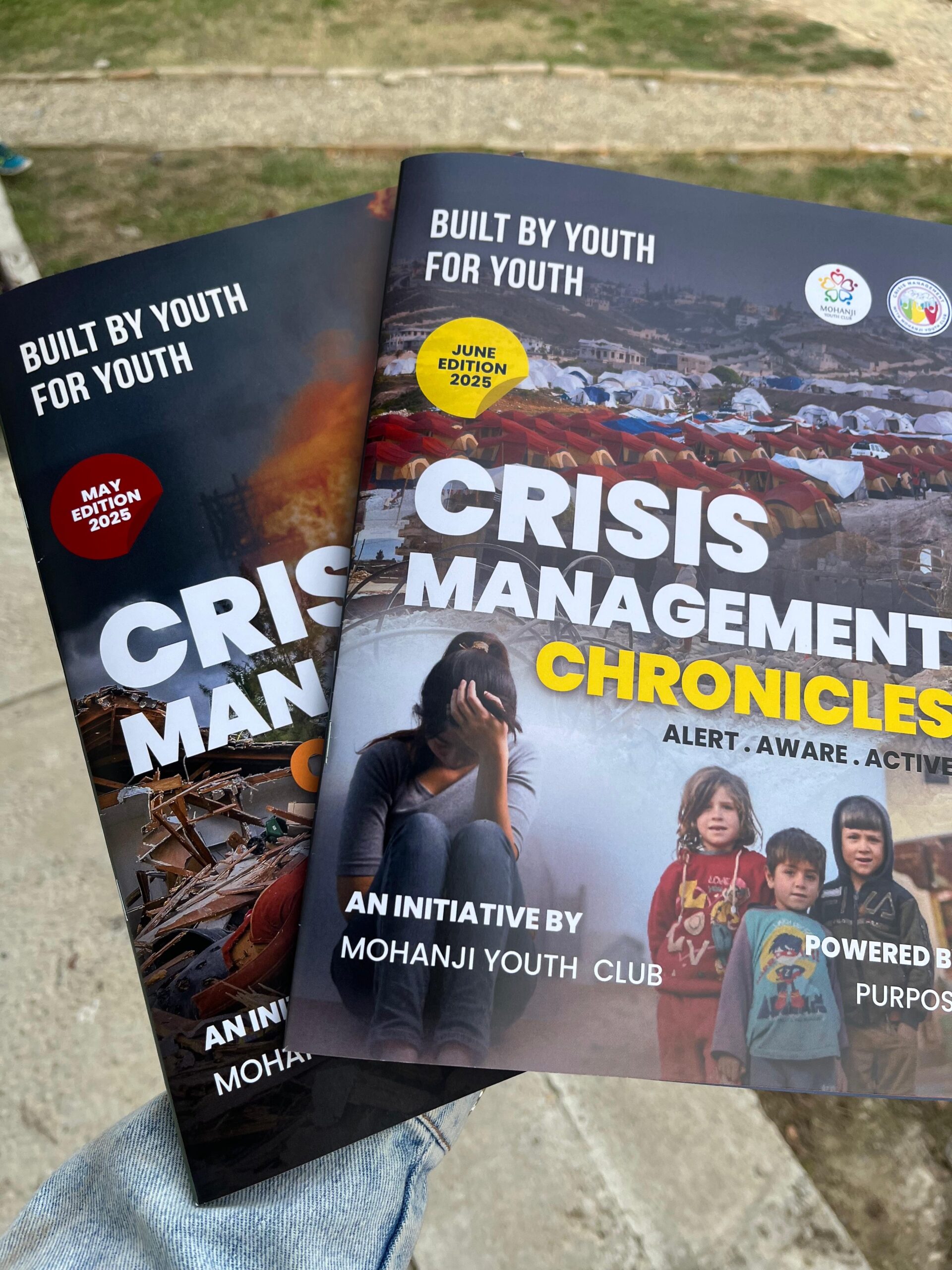
Through our online workshops reaching youth globally, in-person sessions at schools and community centers, and our Crisis Management Chronicles magazine (now in its third edition), we’re creating ripples of stability. Our Instagram content has reached over 200,000 views through 167 educational posts. Our Youth for Youth podcast series lets young people learn from their peers – because sometimes the most powerful teacher is someone who’s just a few years older, speaking your language, sharing what they’ve learned about first aid or crisis response.
We even launched SAAKSH, a mascot designed to make crisis preparedness engaging and accessible for younger children. Because the earlier we start building this foundation, the stronger it becomes.
More Than Survival Stories
One of our newest initiatives, “Stability and Survival Stories,” gets at something essential: survival isn’t just physical. It’s psychological. Spiritual. Emotional.
These aren’t Hollywood hero stories. They’re real accounts of ordinary people who, through inner stability, navigated extraordinary circumstances. A youth who went through anxiety. A person who administered first aid while waiting for ambulances. A person who organized relief during a humanitarian crisis.
What connects all these stories? None of these people had superhuman abilities. They just had something solid at their core – something that didn’t crumble when everything else did.
That’s what we’re building in every young person who walks through our doors.
Looking Forward – Because the Work Continues
Nine months in, we’re just getting started. On February 18th, we’re launching our first crisis awareness music track – because why shouldn’t emergency preparedness have a soundtrack? A Retired Colonel from the Indian Army is joining us February 27th for a critical session on cyber security and online safety, because modern crises don’t just happen offline. Our third Chronicles magazine drops February 23rd.
By the end of 2026, we’re aiming to train over 1,500 youth, expand YOU LEAD to 10 additional cities, launch 15 new podcast episodes, and create 25 youth facilitators who can lead sessions independently. But more than any number, our real goal is simple: create a network of stable, trained young people who can serve as anchors in their communities during any crisis.
The World Needs Stable Humans
As climate emergencies intensify, as uncertainty becomes the norm rather than the exception, the question facing this generation isn’t “Will there be crises?” Of course there will be. The question is: “How will we meet them?”
Through MYC Crisis Management, hundreds of young people are discovering the answer: with stability. Not the kind that comes from avoiding challenges or pretending everything’s fine. The kind that emerges from being prepared externally, centered internally, compassionate naturally, and responsible consciously.
Alert. Aware. Active. This isn’t just about crisis response. It’s a way of being in the world.
And it’s creating a generation that won’t just weather the storms ahead – they’ll become the anchors others hold onto when everything around them is shaking.
The world needs crisis managers, yes. But more than that, it needs stable human beings. And we’re cultivating both – one youth, one session, one transformation at a time.
To learn more about MYC Crisis Management or participate in upcoming programs, reach out at youth@mohanji.org or follow @myc_crisismanagement on Instagram.