Just before the airplane touches down at Kathmandu airport I see the large white stupa. On top of it big almond-shaped peering eyes in a golden face. The sun is almost set and darkness envelops the stupa in a sudden rush, yet a twinkle still sticks on the golden Buddha face. I stay in a rest-house close to where the Swayambunath stands. Next morning, from the rooftop terrace I watch the eyes catching the first sunlight. I am almost eye to eye with Buddha’s eyes and I wait for that twinkle.
I respond and, receptive for eye contact as I am, I receive his blessings.
I have been in Kathmandu many times before. Yet, every time I wonder at the throng of men pushing carts or carrying heavy loads on their backs and I sort of stare at the women, who with a self-possessed movement, carry out their daily activities; all moving around holy cows with whom they share the alleys and pathways. I do not feel I belong to them and to those who do not realize that they walk along such a rich historical past, its oldest descriptions dating back to 400-500 AD. The Kathmandu valley is completely common place to them and so extra ordinary for me.
This time Kathmandu is the starting point of a journey even more into the unknown; my pilgrimage to Mount Kailash, the earthly abode of Lord Shiva, on the Tibetan side of the Himalayas. The Himalayas, an inhospitable mountain range so absolute, that it seems as if nobody would ever be able to cross, yet we have as from times remote.
Mount Kailash is most revered by and of great importance to the Hindus, Buddhists, Jains and the Bonpos, the latter being followers of a pre-Buddhist shamanic religion of Tibetan regions. With some differences of reverence and religious aspects they hold on to the same underlying force and that the human soul is the same at heart. What they also have in common is that many of their respective great saints and spiritual masters have lived close to the holy mountain for times immemorial and meditated acquiring the secret knowledge of Yoga, the governing principles of the universe or the law of nature, which is not easy accessible to everyone.

The narrow precarious passage, known as the friendship highway between Kathmandu and Lhasa winds through steep lush green ‘Himal’ land where danger lurks everywhere, from falling rocks, cascading ice, sudden landslides or a slight miscalculation of the driver. That too could plunge me more than a 1000ft to some grounds below. From the first day of the journey I invoke the lord of Mount Kailash by uttering the words “Om Nama Shivaya” in torment and in joy. On the Tibetan side the ‘highway’ is left behind and the jeep turns west, the rugged road or dirt tracks are full of potholes and are slippery wet from streams coming down from the almighty mountains. It is soon obvious that no images could have prepared me for the overpowering scale and surreal beauty of the landscape which the Tibetan High plateau is, or for the demands of torturous jeep driving. The bumpy ride often feels like a sort of ‘prisoners’ drive in order to make them talk. Alas, it strikes me mute, so mesmerized am I by the infinite horizons, the dry and arid landscapes where there are no trees, no bushes, no birds, no butterflies, just isolation – a nomad’s land.
But monotonous? Oh no! Every vast high-plateau valley is different. One might give way to the silvery Brahmaputri river or another to a turquoise-colored lake and another again to white salt flats. Then too, the surrounding mountains, except for the snow-capped peaks, keep changing colors, depending on the time of the day. Morning clouds and drizzle reflect themselves on different surfaces and then too, the slanting afternoon sunrays assume the delicate tints and tones of old golden colors. Now and then nomads catch my eyes. They live a life as it has been lived for countless centuries.They survive on a diet of dry yak meat, on butter and salt and on products traded, like tea and grains.
Their simple meals are cooked on dung fire, the heat of which is also used to warm themselves during the nights. Though they have warmth in the brightest and sunniest months during summer, the evening temperatures drop sharply, and in winter it dips 40F below. Their life is a life of rearing horses, yaks and goats, of shearing, milking and butchering and trading skin and wool for other necessities. Mere glimpses impress upon me that they live a serene life and are undisturbed, surrounded by the vast pool of consciousness and by the purity of the five elements space, air, fire, water and earth; the elements of which we humans are made of.
I wonder if their arduous life is a struggle for survival, the way I tend to view it, or a victory of humanity. Not to know the answer is obviously caused by obstacles in my own life experiences. While from a distance, watching in awe one of the last examples of a nomad pastoral life, my guide explains that this year the summer has been too dry – yet nomads will not control their environment, they will not irrigate the pastures to enhance the fields, they will adjust, they will flourish one year and fail another as the natural ways of the gods dictate.
The days to reach the camp at the foot of Mount Kailash stretch out and on as I pass through overwhelming vast landscapes. The sojourning of the Aryans occupy my mind. These men were not from the high mountains like the nomads are. They came from the lower lands of upper Sindh. They were amongst the first to see the source of the mighty river Sindhu, and the solitary Mount Kailash when they wandered this region at the dawn of mankind. During the months traversing this highest and most notoriously inhospitable plateau, they experienced distress and anguish as they struggled against the harsh climate and its elements of cold, heat and winds. But they must have felt a sense of protection, imperiously sweeping away their fear and standing proof of the mystical almighty power of Lord Shiva abiding here. The Aryans spread the Sanathana Dharma, the ancient ageless ideals that men must live by right action, right duty and non-violence and that men must live by truth and truth alone. Too, they brought the message that the world is a battlefield and what is required of us is not to be on the winning side but on the right side. 5000 years later what have we learned? What have we learned from the Pandavas, the five brothers , who, under the guidance of Yudhishthira, walked up to ‘heaven’ ( since they passed Badrinath, ‘heaven’ might have been Mount Kailash) and only Yudhishthira himself, the most righteous one reached the destination. All others fell along the path, thus establishing the belief that only the purest of heart can reach the abode of Lord Shiva.
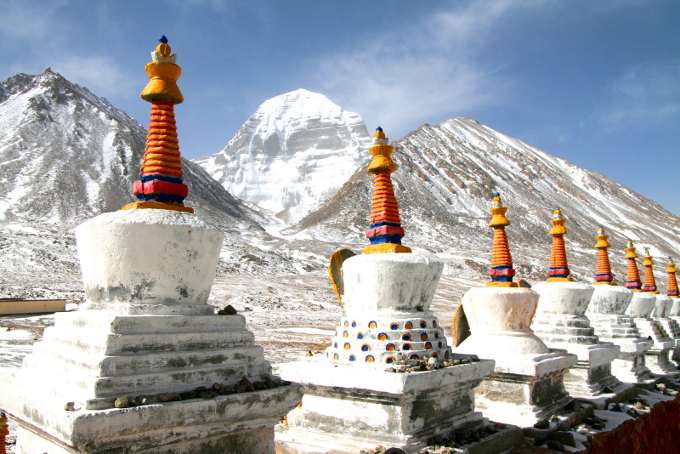
On the 5th day, close to sunset I reach the base camp located between the twin lakes at the foot of Mount Kailash. Suddenly a most blissful moment falls upon the pilgrims. The overcast sky opens, just enough to clearly see the holy mountain far off, albeit its peak covered by a pelerine of bright white snow. This moment brings tears of joy to the eyes of many. A wink from Mount Kailash stirs the human soul. It is love at first sight.

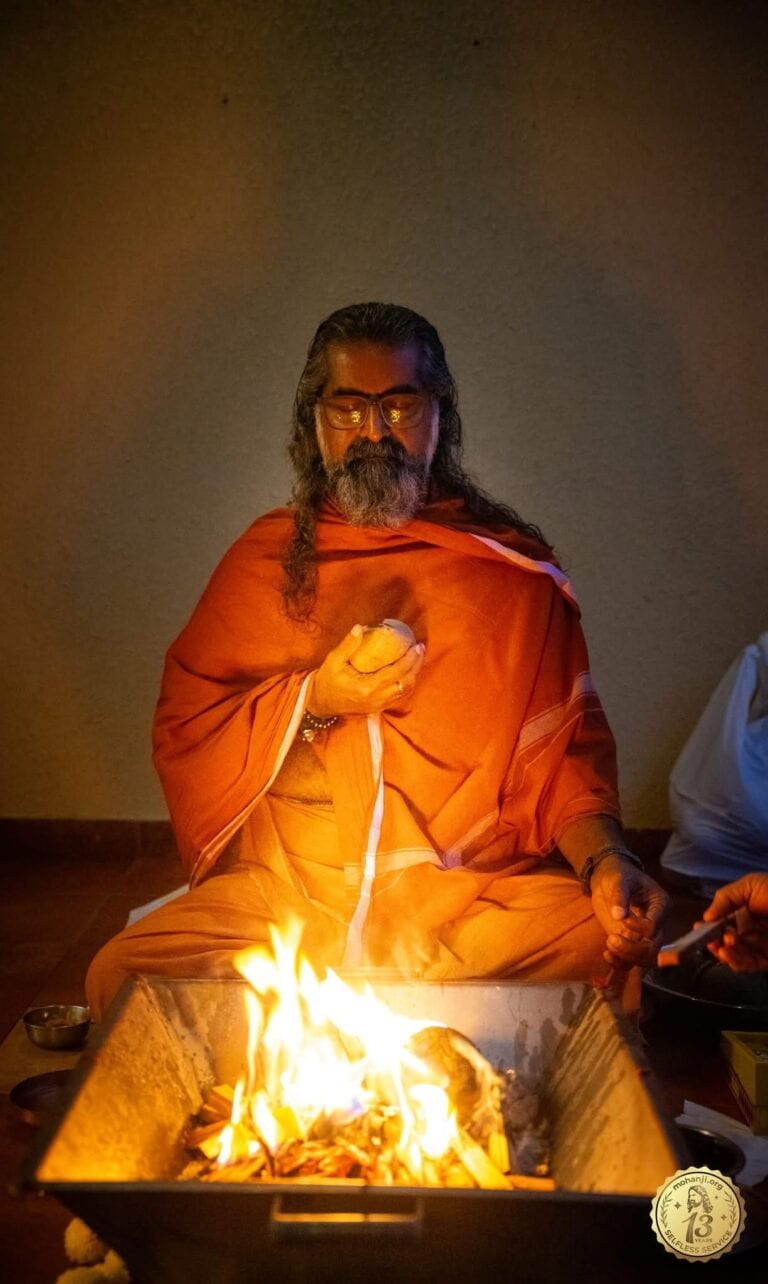
Next day begins with a ‘homa’, a fire offering, a thanks-giving to the gods. Numerous sweet spices like cloves and sweet fruits such as raisins are bit by bit thrown in the fire. Ghee is used as fuel. A sweet fragrance fills the air. And while chanting specific mantras the pilgrims invoke the presence of deities through the eternal clear current. All done properly, a ‘homa’ is most auspicious and removes mental obstacles on the journey. My spirit feels free and pure with joy. I am ready for the pilgrimage. Mount Kailash, on the roof of the world, does not form part of a range. It stands solitary. Its natural architecture is that of a pyramid, with a rounded peak. At a lower level, a ridge encircles the peak, fencing off an all encompassing sacred space surrounding the peak. This space is the playground of Lord Shiva, the unchanging one, and of his consort Shakti, the ever changing one. The sacred space pulsates with awareness and its magnetic field keeps its pilgrims under divine surveillance.
The circumambulation by the pilgrims is done below the ridge. There is no path per se, yet there are many ways to be followed, set out by the ones who went before. It is a journey from the ‘alone’ to the ‘alone’. Every pilgrim will leave the other alone to the greatest extent possible. The journey is an inner one, albeit in the highest mountains of the world with its spell binding ambience. I hold on to my self-reliance as my most precious possession and I put my physical being under control of the mental. As the day wears on, the controlling seems inadequate; the bodily response to my spirit and to the spiritual resonance of the mountains slowly but steadily sets my mind in turmoil. The day has been merely cloudy with a drizzle and the afternoon weather has become bone-chillingly cold. That night, the solid hours of sleep in my warm sleeping bag, hugging my body, serve as an anti-dote. Also my prayers are heard. The next two days the weather is absolutely fabulous.
Lord Shiva certainly has chosen his earthly abode at a location difficult to access. This primordial land is a pure reminder of what the universe is; a vast pool of consciousness. And those who brave the hardship to be here will have the residues of negative karma, at least of this life, destroyed. I pass pilgrims circumambulating Mount Kailash while prostrating at every step. Their spirit must draw energy from their heart, from devotion, and thus their extra self-inflicted suffering is not felt anymore Their breath is silent. Slowly but steadily I let my breath become a silent prayer, a divine moment, a moment of being connected with a divine force, the living force, the gift to mankind, not only to recharge, strengthen and purify the body on a physical level, but on a spiritual level . What I thought I knew, I only begin to truly know now; the breath as the power of the spirit heals the heart when breath becomes a prayer.
The journey spontaneously becomes one of celebration breath and the coming of time whereby neither science nor religion can be the winning side anymore. The science of breath will soon prevail as the unconditional loving life force. By the time I traverse the Dolma pass at 5600 meters, I feel safe in the mountains, in its mystery and its magic. My spirit is light with joy and my joints, ligaments and tendons plough happily through streams and snow and over stony tracks. The last hours at the foot of Lord Shiva’s abode I sincerely wish that many more days could be the same. The jeep is waiting for my return to the base-camp. Pilgrims are reveling in their heavenly rewards. Also, it is the night of the full moon, the night that Parvati, Shiva’s consort descends down. It will be futile to try to use words to describe the scene and the ambience upon my return from Lord Shiva’s abode. I simply drown myself in the crowd.
I will not know what effects the pilgrimage will have upon the rest of my life. The ways of Karma are too complex for the human mind. Yet I do know that my individual consciousness bonded with the Infinite consciousness on deeply felt levels, inspiring me to share my knowledge of Yoga wisdom. Soon after I began writing Yoga, A Many Splendorous Path.
Author: Elise Everarda
www.yoga2live4.com