Author: Azur Ekić
The story of Hanuman comes from the Ramayana, which is an ancient Indian epic traditionally attributed to Valmiki. The exact age of the Ramayana is debated, but estimates suggest it was composed somewhere between 500 BCE and 100 BCE, though the core story may be much older—possibly originating around 1500 BCE as part of early oral traditions.
However, Hanuman’s legend grew over time, appearing in later texts like the Mahabharata (composed between 400 BCE – 400 CE) and various Puranas (between 300 CE – 1500 CE). His worship as a deity also expanded significantly during the medieval period, especially with the rise of the Bhakti movement (12th–17th centuries CE).
So, the story of Hanuman is at least 2,500 years old, but elements of it might go back 3,500 years or more in Indian oral traditions.
But it is not merely the antiquity of his tales that captures hearts; it is the essence of Hanuman’s character: pure, unadulterated devotion. His story, primarily woven into the fabric of the Ramayana, is a testament to the power of unwavering faith and selfless service.
Consider the moment when Sita, held captive in Lanka, was surrounded by despair. It was Hanuman, with his boundless courage and devotion to Lord Rama, who crossed the vast ocean. This act alone is a symbol of overcoming seemingly insurmountable obstacles through faith. But it was not just his strength that moved hearts; but his humility as well. When he found Sita, he delivered Rama’s message, offering solace and hope, and acting as a true messenger.
Then there is the famous instance when Lakshmana was gravely wounded in battle. To save him, Hanuman flew to the Himalayas to retrieve the life-saving herb, Sanjeevani. Not knowing which herb to take, he lifted the entire mountain and carried it back. This act signifies that when fueled by devotion, one can achieve the impossible. It is a powerful example of how devotion inspires action.
Hanuman’s devotion is not about blind faith; it is about a deep, abiding love and loyalty. It is about placing the needs of others before one’s own. It is about recognizing the divine within everyone. His actions teach us that true strength lies not just in physical prowess, but in the strength of character, in the ability to serve with humility and dedication.
Even in the Mahabharata, his presence, though less prominent, reinforces his role as a symbol of strength and righteousness. His appearance on Arjuna’s chariot, on his banner, is said to give Arjuna strength. His presence alone is a boon, symbolizing divine protection and unwavering strength, offering reassurance to those who seek his grace..
Today, thousands of years later, Hanuman’s influence remains profound. Temples dedicated to him dot the landscape, and his name is invoked in times of trouble. His story serves as a beacon, reminding us that in a world often filled with uncertainty, devotion, courage, and selfless service can guide us through any darkness. He is the embodiment of the power of faith, a timeless inspiration to devotees across generations.
If you have a story to share about Hanuman, please do so in the comment section below. To start first and to perhaps inspire you, let me share a short and sweet leela that happened while I was preparing to write this text.
Today, while I was shopping for some tools, I noticed a woman with a strange face at the cash register. Her lips were completely swollen, obviously filled with botox. It was hard not to stare at her, I am not sure if I had ever seen a face similar to that one in person, only on the internet or the TV.
As I had returned home, I started researching stories about Hanuman, so naturally – I wanted to see what Mohanji – the founder of our magazine, had to say about Hanuman, also hoping to read about some devotee experiences.
I ran into an article from the Mohanji Chronicles, titled “Miracles of Lord Hanuman”.
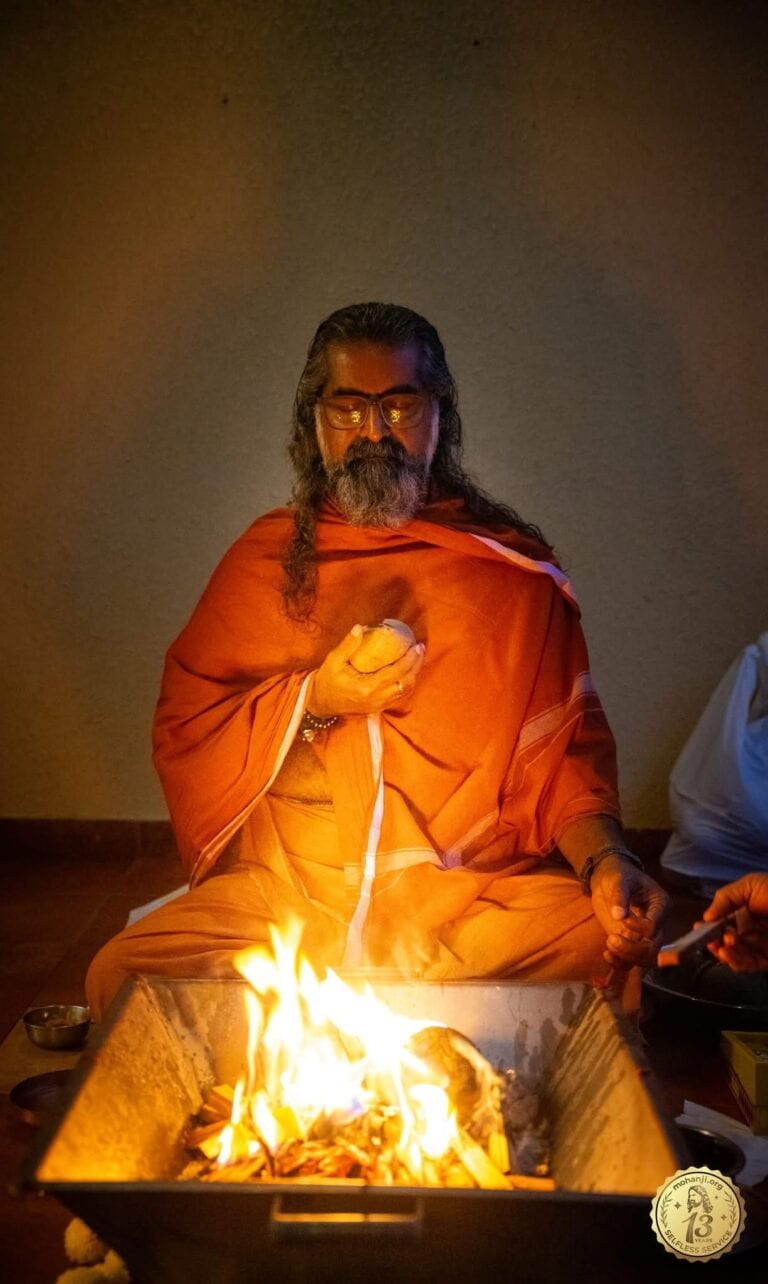
As I had scrolled down, I could not help myself but laugh. Why? Because this is the photo that appears in the article:
Other than it being a leela, it also reminded me of the so-called monkey mind (in Hinduism and Buddhism, the ‘monkey mind’ refers to the restless, distracted, and unsettled nature of our thought, like a monkey jumping from one branch to another) and something was telling me to remind the readers about this.
Even though I could have stopped staring if I wanted to, it reminded me how our mind, when we see something unusual and new, feels naturally drawn to it, unless tamed.
Hanuman, with his unwavering faith and devotion, serves as a powerful example of how we can tame this restless mind. His single-minded devotion to Lord Rama teaches us that through faith, discipline, and selfless service, we can harness the power of our minds, just as Hanuman channels his immense strength in service of the divine. By focusing on a higher purpose, as Hanuman does, we can quiet the distractions of the monkey mind and cultivate a deeper, more focused inner peace.