It was a rainy night. The cowherd damsels left home in the dead of night, as usual, to join their beloved on the banks of the Jamuna. They arrived on time, but he was late. Finally, the moon illumining his already-resplendent face, he entered with a mischievous smile. “Oh beloved, you’re rather late today!” they exclaimed. He turned to them and said pensively, “Yes, today I had a special guest. You perhaps know him. His name is Durvasa. I was busy attending to him.” He then added, “If you placate him with sweetmeats, he may grant you a boon.”
A shiver ran down their spines.
Who didn’t know Durvasa? Was he not the sage whose infamous temper had been elucidated at length in the Puranas and Mahabharata?
“But how do we get across the Jamuna in the dead of night?” they cried.
“Ah! Quite simple! Just tell the Jamuna river I’m a perfect celibate; she’ll part her waters and let you pass.”
“Incredible!” they thought.
They gathered the sweetmeats they had and set off to the hermitage of Durvasa. Surprisingly, the Jamuna let them pass.
The gopis arrived at the hermitage of Durvasa. The sage had a frightening demeanour; his dishevelled hair and untidy appearance were far from welcoming. He nevertheless received them warmly: “Oh! I’ve been expecting you’ll. I hope you have plenty of sweetmeats for me.”
There was an unmistakable air of predestination about the whole affair.
Durvasa greedily partook of all he was offered. He ate what appeared to be a mountain of food. And he belched in satisfaction.
“Return to your beloved,” said the sage. “Your innermost desires shall be fulfilled.”
“But how do we cross the Jamuna again in the dead of night?” they cried.
“Quite simple,” he said. “Say to her that if Durvasa has eaten anything other than dried leaves to satisfy his hunger, she need not let you pass.”
“Incredible!” they thought. And they left.
Indeed, the Jamuna parted once again! They were finally back with their beloved.
He was waiting for them under a kadamba tree, the same mischievous smile on his lips.
“Oh, beloved! We don’t understand you at all! We are married women and you are our paramour. Yet you insist you’re a perfect celibate, and Jamuna, too, seems to agree. Across the Jamuna, Durvasa partook of mounds of food and insisted he sustained himself only by consuming dried leaves. What is the secret to this riddle, oh Krishna?”
“It’s very straightforward,” he said. “You see, all entities in the Universe are my expansions. So when we sport as lovers, I am only frolicking with myself. Moreover, I am free of any desires even though I am the paramour of you all. As for old Durvasa, he indeed sustains himself only on dried leaves. What he ate today was an offering for me. Durvasa was only the instrument. I alone consumed all your sweetmeats, because I reside in Durvasa’s heart and his consciousness is wholly given to me!”
“You defeat us again today,” said the gopis is utter exasperation. Such was his inscrutable logic!
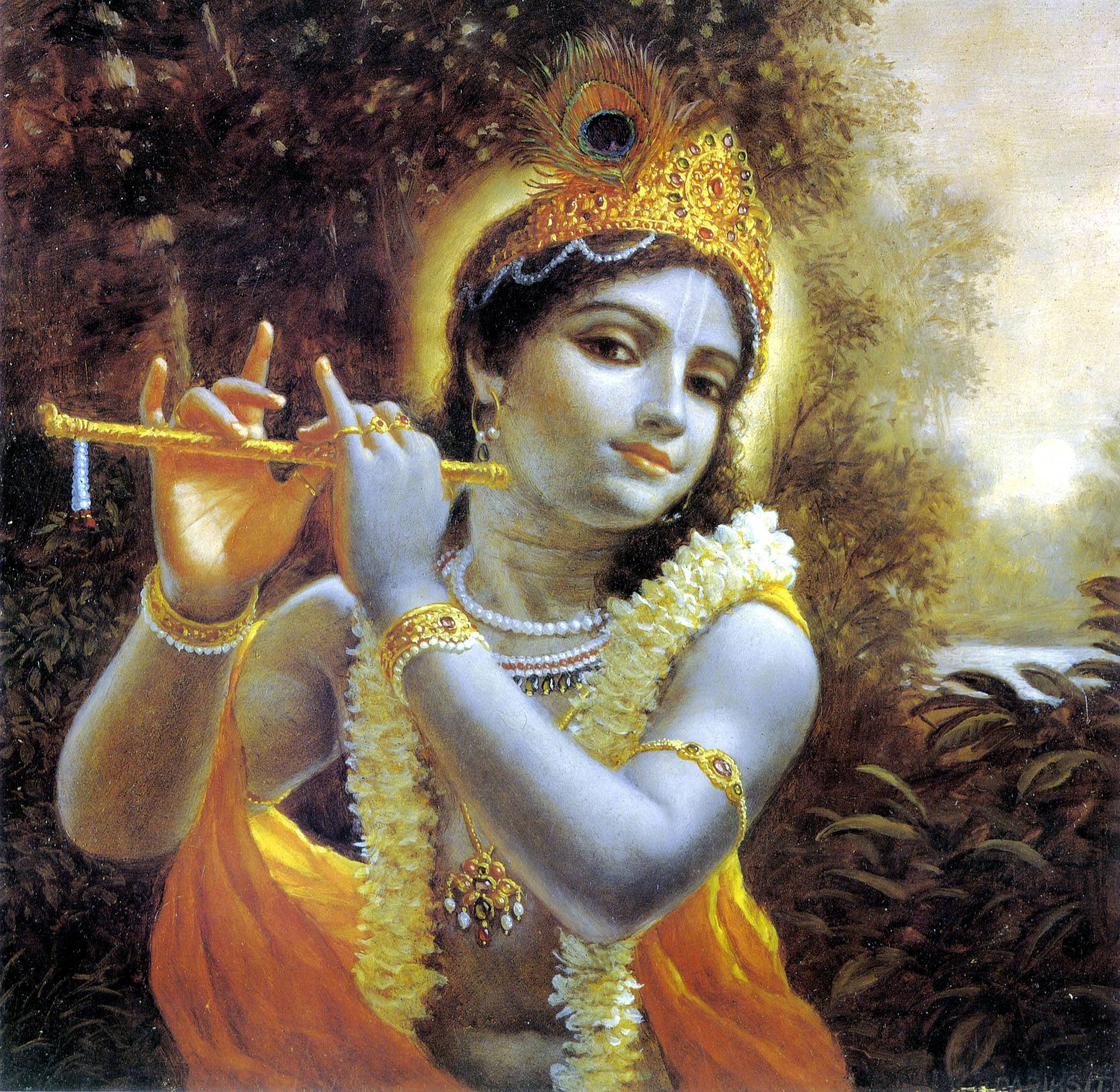
Very rarely does one come across a personality who resists all attempts at classification. He shines as an individual, a leader, a husband, a lover, a master strategist… one can give him any label, but he’s beyond all labels. Krishna is that peerless character from the Mahabharata and Srimad Bhagavatam who manages to be something to everyone but nothing to anyone.
Krishna is described as the supreme avatar in the Srimad Bhagavatam, a text with some 18,000 Sanskrit verses that deals with the esoteric life and instructions of the dark-hued Lord.
Krishna is the speaker of the famous Bhagavad-gita, which was delivered to the despondent warrior-prince Arjuna on a battlefield, just before the start of a terrible war.
Known by names such as Syamasundara, Giridhar, Govinda, Gopala, Janardana, Acyuta, Gopijanavallabha, Krishna is the supreme example of a being who executes every action in perfect awareness. Every aspect of Krishna’s life is profoundly instructive.
So is Krishna God, a divine personality, or just a mythical figure? There are no easy answers! Decide for yourself after reading the key teachings from the life of Krishna.

Cardinal Precepts of Lord Krishna
1. Uncertainty is unavoidable. Detachment is the key to an effortless existence.
Krishna was born in a prison cell. His own uncle tried to kill him using various devious means. He was born of one woman, but raised by another. He had to move his kingdom to avoid an unnecessary war. He oversaw the destruction of his own family. He was a kingmaker, but did not sit on a throne himself. The solution to uncertainty is given by Krishna himself in the Gita:
yadā saḿharate cāyaḿ
kūrmo ‘ńgānīva sarvaśaḥ
indriyāṇīndriyārthebhyas
tasya prajñā pratiṣṭhitā
One who withdraws their senses from sense objects, like a tortoise, which draws its limbs within the shell, is established in perfect consciousness.
Suffering exists in so far as attachment and aversion exist. If one accepts whatever one receives in life without judgement, the journey becomes much easier. This is not to be mistaken for an attitude of passive resignation. Rather, acting consciously and proactively is the path to tranquillity. The dualities of life such as joy/sorrow, pain/pleasure, success/failure do not affect one situated in perfect consciousness.
2. The cynic is ruined by doubt.
The world is filled with impostors. In the era of 24-hour news, we hear constantly of fraud, theft, and exploitation. This has made people needlessly cynical. While modern science teaches us to question everything, it fails to understand that the intellect has its limitations. Faith begins when doubts end, and faith truly throws open the doors to higher experiences and realization. So Krishna tells us, saṁśayātmā vinaśyati: for the doubting soul, there is no lasting happiness.
Many people consider their material life to be different from their spiritual life. It is widely held that faith is essential only in the spiritual realm, but not in the material realm. But the Masters draw our attention to the fact that the mundane and spiritual aspects are but part of the one vast continuum of existence. Thus even these distinctions are arbitrary.
All truly enlightened souls have dared to walk the path of faith. Do you?
3. There is something that is truly unchanging. Discover it.
The phenomenal world is characterized by change. From childhood, we progress to youth, old age and, finally, death. Yet these changes affect the body alone. There exists something that is a witness to these changes while remaining entirely unaffected. It is this spark of consciousness that animates the body. It just is.
So the next time you’re enjoying a delicious ice cream or crying over a heartbreak, ask yourself what was gained or lost. Who gained, who lost?
Author: Shlok Kumar, TAT editorial team